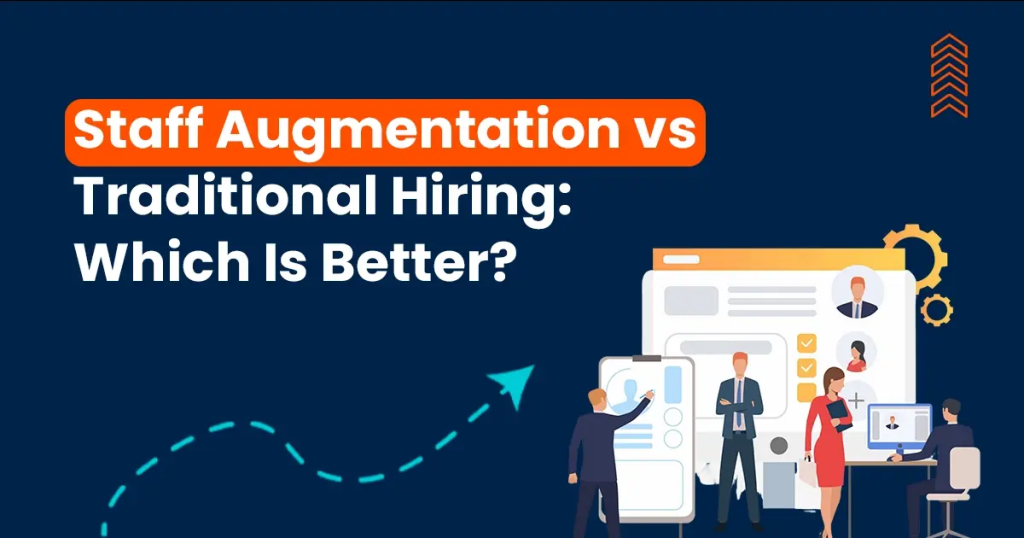
Is your business like others competing for a talented and professional workforce adaptable to changing market demands, with enough potential to make strategic business decisions? You are seeking the right talent through the right choice. One triggering question continues to dominate the leadership discussions. Should businesses prefer conventional hiring or lean on staff augmentation?
While both models allow companies to acquire potential talent, staff augmentation significantly differs in cost, scalability, speed, risk, operational efficiency, and long-term value. A right choice directly influences the project’s delivery timelines, financial scope and market value. This insightful guide shares how staff augmentation compares with traditional hiring to find the best fit for your business needs.
Staff Augmentation vs Conventional Hiring|Comprehensive Overview
Staff augmentation is a prevalent model in the modern business landscape. Businesses can choose skilled professionals to provide their services as an integral part of their internal work team. These experts process and integrate their specialities into the existing workflows in compliance with the organisation’s policies. This model works by filling the talent gaps, sharing the workload and providing niche specialists when required.
When should companies choose staff augmentation? What are the pros and key limitations? These common concerns seem to pivot modern business discussions. Let’s unfold them step by step.
When to Prefer Staff Augmentation?
- When a company needs quick access to a skilled workforce.
- When internal teams are overburdened and require an additional capable workforce.
- When a business needs dedicated resources for a single project or goal. This avoids splitting time across multiple initiatives.
- When an organisation wants to maintain firm control over every execution.
- When a company is no longer interested in long-term hiring commitments.
What are the Pros of Staff Augmentation?
- This model ensures a faster hiring cycle. A skilled professional is accessible within days, not months.
- This is a cost-efficient approach. No recruitment, training, onboarding, or insurance costs are involved, and no employee benefits are required to offer.
- Companies can easily access niche-based and exclusive resources with specialised skills, including UI/UX designers, QA testers, developers, cloud engineers, DevOps experts, AI professionals, and SAP consultants.
- This is a profitable option with high flexibility, where companies can easily scale the resources as project demands change.
- Companies can even adopt strategic offshore staffing to access global talent with specialised skills and smartly manage local talent shortages.
- No long-term risk is involved as this model allows companies to avoid commitments, unwanted notice periods or other workforce liabilities.
Limitations in a Snapshot
- Successful staff augmentation requires strong internal leadership and proper task management.
- This model only outperforms when the responsibilities are predefined, and no distractions exist.
- This approach may not fit well for responsibilities requiring long-term organisational alignment.
Traditional hiring is an effort to recruit full-time talent for permanent roles. These employees are hired to become part of a company’s workforce for the long-term. Monthly salary and other benefits are part of employment. This is how they become a part of an organisation’s internal culture and long-term business strategy.
When do Companies Select Conventional Hiring?
- When long-term roles are required with ongoing responsibilities.
- When a company cannot afford to expose its internal intellectual property or sensitive operations.
- When the defined roles demand longer commitments and alignment with business goals.
- When a company is more focused on building a permanent workforce and its core operations.
What are the Benefits of Traditional Hiring?
- Permanent workforce works with a sense of full ownership in an organisation’s internal culture to achieve a long-term vision.
- Permanent staff can be easily assigned different roles, measuring their potential, and they can remain active across multiple project cycles.
- Team collaborations are stronger and long-term in a permanent model where permanent employees can smoothly integrate into the company’s environment.
- Permanent hirings suit strategic roles and leadership goals such as operations leads, engineering managers or professional architects.
Understanding the Limitations
- The traditional model requires long hiring timelines.
- Costly approach due to monthly salaries, employee benefits, office space and other assets.
- Less or no flexibility when workloads increase, and eventually operational disruptions pop up.
- This model is costly for many modern businesses and difficult to scale or downsize on demand.
- Employee turnover risks and more replacement delays encircle the company.
What are the Real-World Use Cases?
Staff augmentation performs best:
- Cloud migration and expert IT recruitment include cloud architects, SAP BTP consultants or DevOps engineers.
- Rapid product development requires additional developers and QA experts to speed up the release process.
- On-demand specialists include cybersecurity, data engineers, automation and AI experts.
- Project-based staffing is profitable for short-term and mid-term projects.
Traditional hiring works excellently:
- Leadership roles are required, including team leads, CTOs and engineering managers.
- Functional permanent positions that require long-term commitments and responsibilities.
- Specific domain-based roles are important for compliance and better product management.
What is a Hybrid Model?
Confused? Don’t be overwhelmed by the term. Many organisations are experimenting with the best of both worlds (staff augmentation and traditional hiring), commonly known as a hybrid model.
This third modern approach is a combination of staff augmentation for project execution and conventional hiring for strategic and long-term roles. This combined approach improves speed, optimises cost and also ensures the company’s control over key operations.
Which Model is Ideal for Better Results?
By the end, every business organisation is keen to discover the most dependable model with proven results. Both recruitment strategies come with their own set of advantages and bottlenecks. If your business strategy is still up in the air, let’s not sit on the fence any longer. Lean on the right model based on your company’s needs. Your decision is based on the close consideration of the following factors.
- Project duration is a very important factor, whether it is short-term or long-term.
- Whether specialised skills are required immediately or a role can sustain long-term training.
- Whether the business goals require short-term or long-term budget allocation.
- Whether the team dynamics support external experts or long-term workforce cohesion matters.
Many successful companies are experiencing a blended version of both models today. This means a hybrid approach. If a close analysis of all the above shared factors leads you to staff augmentation to fulfill your business needs, here you go. Tekboox is a trusted partner with more guaranteed results and cost efficiency. Feel easy to contact us anytime for scalable, flexible and tailored recruitment solutions. Let’s choose the right approach to streamline your business operations to get the desired outcomes.